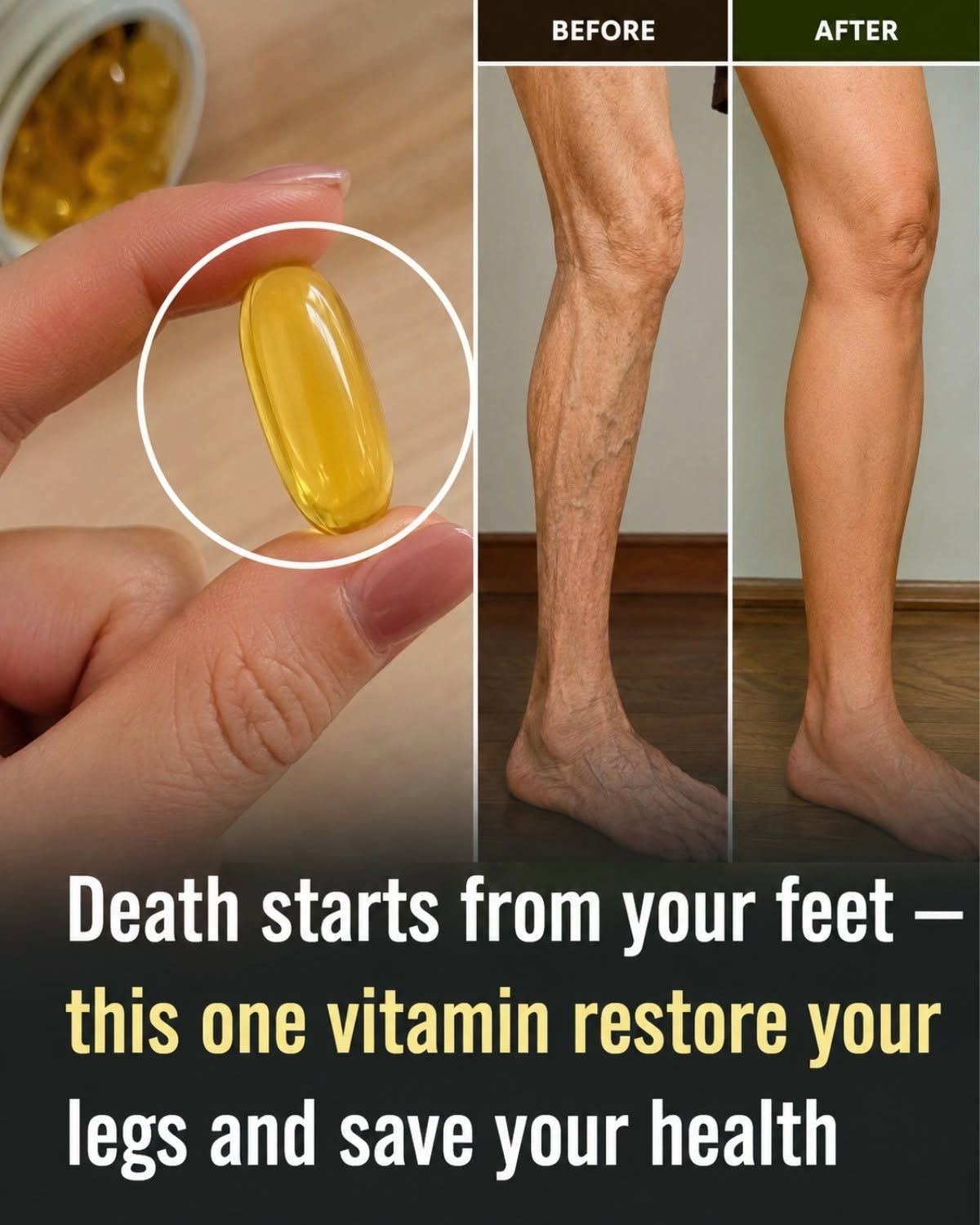
Vitamin C: The Alarm Bell Your Legs Have Been Ringing
Vitamin C plays a critical role in circulation that rarely makes the headlines. Beyond immune health, it is essential for building collagen—the natural structural scaffold that stops blood vessels from becoming brittle and sluggish. Think of it as a rust-stripping agent against the oxidative stress that chokes off blood flow to your feet and calves.
This matters when your legs stay cold in a warm room, go numb after sitting, or feel heavy and unresponsive the moment you stand up. This isn’t just ‘getting older’—it’s often a vessel network that has grown stiff, dry, and overworked from years of strain.
Imagine a garden hose left under the hot sun for too long. It kinks, cracks, and resists pressure rather than delivering a smooth stream of water. That is precisely what rigid blood vessels do to the blood trying to reach your toes.
When Vitamin C begins doing its job, you won’t see a dramatic, movie-style miracle overnight. Instead, you’ll notice subtle, vital changes: less dead-weight heaviness by the evening, fewer icy toes under the blanket, and a renewed sense of mobility when you get up from the couch.
Yet, the $100-billion wellness industry rarely champions simple fruits, simply because there is no profit empire in reminding people that the body can rebuild its own vessel walls using basic raw nutrients.
Niacin: Opening the Gates for Trapped Blood
Niacin (Vitamin B3) acts like a digital switch—widening blood vessels and allowing circulation to flow with far less resistance. When your legs are starved of blood, they complain immediately: tingling, coldness, a dragging sensation, or that strange ‘sleeping’ feeling in your feet.
Picture a crowded highway tunnel during rush hour. Traffic is backed up, horns are blaring, and nothing is moving. Niacin is the moment that tunnel expands by two lanes, letting traffic breathe again.
This dilation is crucial in the extremities, far from the heart, where blood struggles most to reach the tiny capillaries of your lower legs and feet. When flow improves, walking across the room stops feeling like an uphill battle.
As a bonus, improved circulation often restores a healthy glow to dull skin. After all, your face and your legs rely on the very same circulatory blueprint.
Iron: Delivering Oxygen to Starved Calves
Iron is non-negotiable. It is the core mineral required to build hemoglobin—the delivery fleet responsible for hauling oxygen to the tissues that burn out first when supply drops: your calf muscles, your toes, and every area that feels weak, cold, or drained.
Without sufficient iron, your body may have plenty of blood volume, yet still fail to deliver oxygen where it counts. That is why low iron can make you feel like you’re walking through wet cement, even when your lab results look ‘fine.’
Think of a distribution warehouse with half its delivery trucks missing. The orders are packed and ready, but nothing arrives on time. That is the exact impact of low iron on your muscles.
When iron levels recover, the difference shows up in daily moments: stairs stop feeling like a punishment, the afternoon crash loses its bite, and your legs no longer ache for a chair after a brief walk.
Vitamin E: Shielding the Pipes from Internal Wear
Vitamin E acts as a protective shield along your vessel walls. It neutralizes microscopic damage before it turns smooth, fluid circulation into an irritated, sticky, and obstructed ordeal.
When vascular damage accumulates, your legs pay the price first: feet turn cold, calves tighten up, and your lower body feels like its supply lines are choked by internal grime rather than physical fatigue.
Picture a plumbing system coated with greasy buildup. Water still passes through, but it loses force, and every bend in the pipe creates drag. Vitamin E helps keep that inner surface slick, clean, and resilient.
Magnesium: Unclenching Overworked Vessel Walls
Magnesium is the ultimate release valve. It signals blood vessels to relax rather than clamping down like a tight fist—a lifesaver when your legs feel restless, tense, or overworked at the end of the day.
When magnesium runs low, your entire vascular network can feel like a clenched hand that refuses to open. Blood has to push harder, muscles stay guarded, and your lower body braces for impact instead of receiving vital nutrients.
Imagine a drawbridge jammed halfway up, causing traffic to pile up on both sides. Magnesium is the smooth lowering mechanism that restores the flow.
You’ll notice the shift during quiet hours: less nighttime leg tension, a relief from deep internal tightness, and a body that finally stops resisting itself.
Why Your Legs Feel the Hit First
Your feet and calves are the farthest outposts from your heart. They are the first to suffer when circulation slows, vessels stiffen, or oxygen delivery drops.
Your body isn’t being dramatic—it is sending an urgent message through cold toes, heavy calves, and pins-and-needles sensations. Once these signals start, they follow a distinct pattern: after prolonged sitting, under the covers at night, or during a routine walk.
The solution is rarely a single silver bullet. It requires a strategic combination of raw biological fuel, vascular support, and protective antioxidants to keep the network from hardening into a standstill.
One Simple Mistake Can Stop the Process Cold
Even the best nutrients fail if you pair them incorrectly or take them with a stack that blunts absorption. A poorly timed routine can turn essential vitamins into expensive waste.
Iron, in particular, is easily blocked if taken without its proper nutrient partners. Your digestive system is highly selective, and the wrong combination will lock the gate entirely.
Get the pairings right, and your circulatory system stops feeling like a clogged drain and starts running like an open highway.
For Complete Cooking STEPS Please Head On Over To Next Page Or Open button