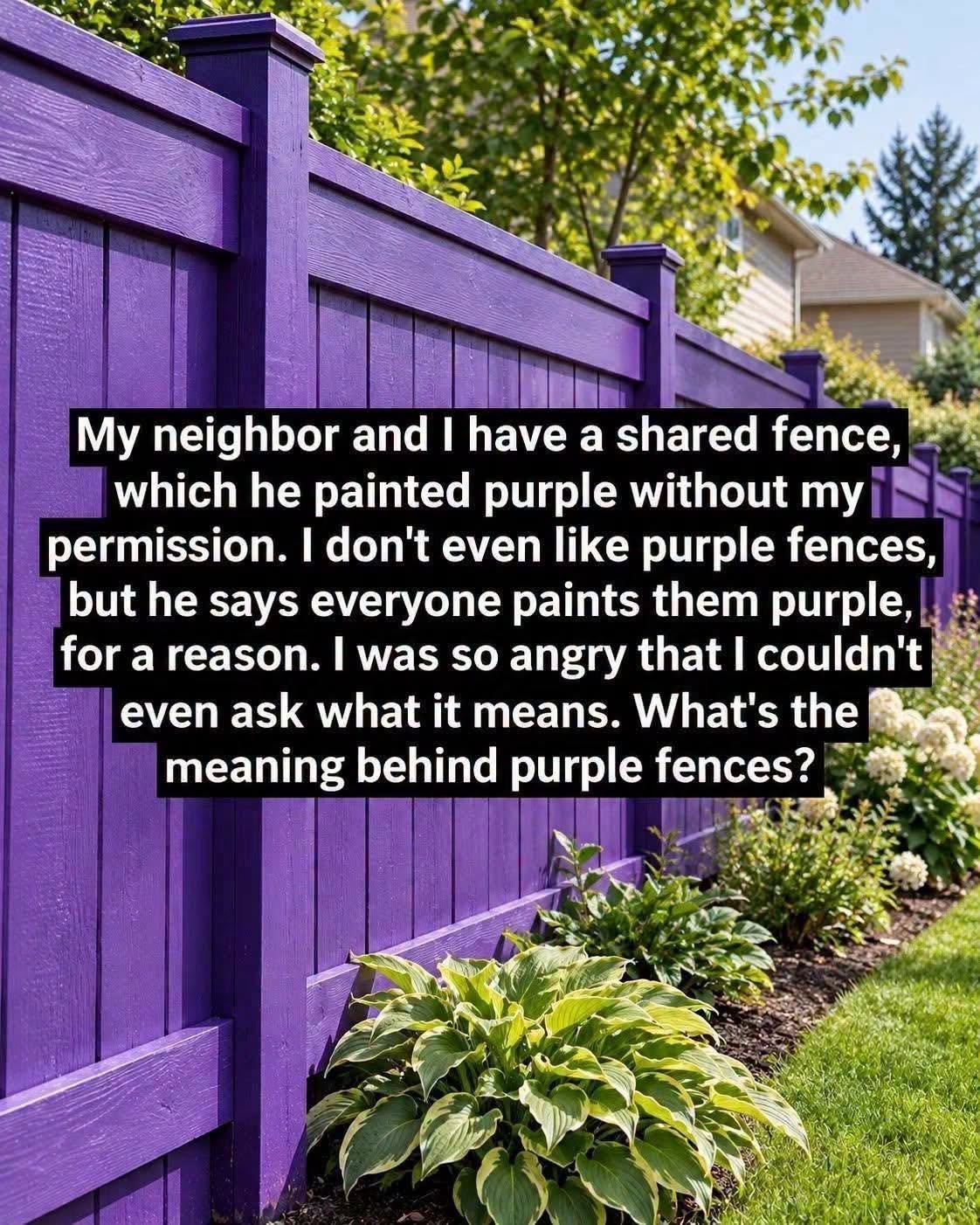
Imagine walking along a quiet country road, exploring a wooded trail, or driving past a rural property when you suddenly notice something unusual: a fence post, tree trunk, or section of fencing painted bright purple.
At first glance, you might assume the color is simply a decorative choice. Perhaps the property owner wanted something different from traditional white or brown fencing.
But in certain parts of the United States, purple paint can carry an important legal meaning: No Trespassing.
This surprising practice is known as the Purple Paint Law, and understanding it could help you avoid accidentally entering private property.
Although the rules vary from state to state, the basic idea is simple. Instead of relying exclusively on traditional warning signs, property owners in some jurisdictions can use clearly visible purple markings to communicate that entry is prohibited.
Here’s what you should know about purple fences, why the practice exists, and what to do if you encounter one.
What Does a Purple Fence Actually Mean?
In several U.S. states, purple paint on fences, trees, or posts can serve as a legally recognized warning against trespassing.
The markings communicate that the land is privately owned and that unauthorized entry is not permitted.
This means that a purple-painted fence or a series of purple marks on boundary posts may have the same legal purpose as a traditional “No Trespassing” sign, provided the markings satisfy the applicable state law.
However, there is an important distinction.
Not every purple fence is automatically a legal no-trespassing notice.
Some fences are painted purple for decorative reasons, and some states do not recognize purple paint as a substitute for posted signs.
The legal meaning depends on the location, the type of marking, and the relevant state requirements.
Nevertheless, when you encounter purple markings on rural property, the safest approach is to respect the boundary and avoid entering without permission.
Why Do Property Owners Use Purple Paint?
At first, using paint instead of a sign might seem unusual.
However, there are several practical reasons why landowners choose this method.
1. Purple Paint Can Last Longer Than Signs
Traditional “No Trespassing” signs may deteriorate over time.
Rain, snow, wind, and sunlight can damage printed materials, making the signs difficult to read.
Signs can also become detached from posts or trees.
Paint, when properly applied and maintained, can remain visible for a relatively long period.
This makes it a practical alternative for marking large rural properties.
2. Signs Can Be Removed or Damaged
Another reason property owners use purple paint is that physical signs can be stolen, vandalized, or knocked down.
A painted marking is less easily removed.
Although paint may fade over time, it generally requires more effort to eliminate than a sign attached with nails or screws.
3. Large Properties Need Many Boundary Markers
Farmers, ranchers, and woodland owners may have hundreds of acres of land.
Installing and maintaining signs along every section of a property boundary can be expensive and time-consuming.
Purple paint allows landowners to mark multiple trees or fence posts at designated intervals.
When applied according to state regulations, these markings can provide a recognizable warning to people approaching the property.
Where Did the Purple Paint Law Come From?
The use of purple paint as a property-boundary warning developed in the United States as an alternative to conventional trespassing signs.
Arkansas was among the earliest states to adopt this approach, establishing a purple paint law in 1989.
Over time, other states introduced similar legislation.
The exact requirements differ considerably.
Some states recognize purple markings on trees or posts, while others impose additional restrictions concerning placement, visibility, or the type of property involved.
In certain jurisdictions, purple paint may be one legally accepted way to communicate that land is closed to unauthorized entry.
In others, signs or other forms of notice may still be required.
This variation makes it important to understand local regulations rather than assuming the same rules apply everywhere.
Which States Recognize Purple Paint Warnings?
Several states have enacted laws allowing certain purple paint markings to serve as no-trespassing notices.
Examples include:
- Arkansas
- Missouri
- Texas
- North Carolina
- Illinois
- Kansas
- Pennsylvania
- Tennessee
Other states also have related provisions, and the list and legal requirements may change.
Importantly, these laws are not identical.
A marking that satisfies the requirements in one state may not meet the requirements in another.
Some jurisdictions specify exact dimensions and placement rules, while others have additional conditions.
Anyone planning to mark their property using purple paint should consult the current law in their state.
Why Is Purple Used Instead of Another Color?
Purple was chosen partly because it is relatively distinctive in many outdoor environments.
Natural landscapes contain numerous shades of green, brown, gray, and yellow.
A vivid purple marking can stand out against tree bark or wooden fence posts.
The color also helps create a recognizable visual signal that differs from ordinary environmental markings.
Another frequently mentioned consideration is that purple can be distinguishable from common red-green color-vision deficiencies, although visibility still varies among individuals and environmental conditions.
Ultimately, the legal significance comes from the relevant statute, not from any universal meaning of the color itself.
What Do Legal Purple Paint Markings Look Like?
A legally recognized purple paint warning is not necessarily an entire fence painted purple.
In many states, the law describes specific vertical paint marks placed on trees or posts.
The markings must often meet minimum dimensions and placement requirements.
For example, some state laws require vertical lines at least eight inches long and one inch wide.
They may also specify that the marks must be placed within a particular height range above the ground.
Other requirements can include the maximum distance allowed between markings.
These details matter because a random splash of purple paint may not qualify as legally sufficient notice.
The exact specifications depend on the jurisdiction.
What Should You Do If You See a Purple Fence?
If you encounter purple paint markings while hiking, hunting, fishing, or exploring rural areas, the best response is to treat them as a possible private-property warning.
Avoid crossing the marked boundary unless you have permission from the landowner or a clear legal right of access.
Do not assume that the absence of a traditional sign means entry is permitted.
If you are uncertain whether a trail crosses private land, consult official trail maps or contact the relevant land-management authority.
Respecting property boundaries helps prevent misunderstandings and protects both visitors and landowners.
Can You Get in Trouble for Crossing a Purple-Painted Boundary?
Potentially, yes.
In states where purple paint markings are legally recognized, crossing a properly marked boundary without authorization may expose someone to trespassing penalties.
The consequences depend on state law and the circumstances.
Penalties may include fines or other legal consequences.
However, not every instance of entering private property automatically constitutes a criminal offense.
Trespassing laws may involve additional elements, exceptions, or notice requirements.
The legal effect of purple paint depends on whether the marking complies with the applicable law.
This is another reason to avoid making assumptions about unfamiliar property boundaries.
What If the Fence Is Completely Painted Purple?
A fully purple fence may look striking, but its meaning is not always straightforward.
Some property owners choose purple simply because they like the color.
Others may use it to reinforce a no-trespassing message.
However, where statutes require specific vertical marks, painting an entire fence purple may not satisfy the legal notice requirements.
Therefore, the appearance of a purple fence alone does not establish that the owner has complied with the state’s purple paint law.
Nevertheless, the presence of a fence is itself a reason to consider whether the land is private.
It is always sensible to seek permission before entering property that does not belong to you.
Why This Warning Is Especially Important for Hikers
Outdoor enthusiasts frequently travel through areas where public and private land are located close together.
A trail may pass near farmland, wooded property, or private hunting grounds.
In some locations, property boundaries are not immediately obvious.
Purple paint markings can provide an additional clue that a particular area is not open for public access.
Hikers should pay attention to official signs, maps, fences, and other boundary indicators.
If a trail appears to lead into a marked private area, it is better to verify the route than to continue without knowing whether access is permitted.
Purple Paint and Hunting Areas
Purple paint laws are particularly relevant in rural areas where hunting is common.
Hunters may encounter painted trees or fence posts along wooded boundaries.
These markings can indicate that a landowner does not permit unauthorized entry.
Even when hunting is otherwise allowed in a region, private property rights still apply.
Hunters should verify land ownership, obtain required permissions, and follow applicable hunting regulations.
A hunting license does not automatically grant permission to enter private land.
Why Property Boundaries Matter
Property boundaries serve several important purposes.
They help establish ownership, clarify responsibilities, and reduce disputes between neighboring landowners.
Clearly marked boundaries can also protect agricultural operations, livestock, equipment, and natural resources.
For visitors, recognizing boundary markers reduces the risk of accidentally entering restricted areas.
Purple paint is simply one method that some states permit landowners to use for communicating those boundaries.
Common Myths About Purple Fences
Because purple paint laws are unfamiliar to many people, several misconceptions have spread online.
Myth 1: Every Purple Fence Means No Trespassing
Not necessarily.
The legal meaning depends on state law and whether the markings meet statutory requirements.
Myth 2: Purple Paint Laws Apply Throughout the United States
False.
These laws exist in particular states, and their requirements differ.
There is no single nationwide purple paint rule.
Myth 3: A Landowner Can Paint Anything Purple and Automatically Prohibit Entry
False.
Where purple paint is recognized as legal notice, specific placement and marking rules may apply.
Myth 4: Purple Paint Means the Property Is Dangerous
Not inherently.
The markings are generally intended to communicate a property-access restriction, not necessarily the presence of a physical danger.
Myth 5: If There Is No Purple Paint, You Can Enter
False.
Private property may be protected by trespassing laws even when no purple paint is present.
How Landowners Can Use Purple Paint Responsibly
Property owners interested in using purple paint should first review their state and local laws.
They should determine whether purple paint is recognized as legal notice and what specifications apply.
Before marking a boundary, it is also important to confirm the correct property lines.
Painting trees or posts that belong to a neighbor can create disputes.
Landowners should use durable, clearly visible paint and maintain markings as necessary.
If the law requires additional signage or other forms of notice, those requirements should also be followed.
Properly applied boundary markers can help communicate restrictions clearly and reduce confusion.
Why So Many People Are Surprised by This Rule
One reason purple paint laws attract attention is that the meaning is not immediately obvious.
Most people associate purple with creativity, flowers, decorations, or personal expression.
They do not expect it to have a legal function.
As a result, someone may pass a purple-painted tree or fence post without realizing it could represent a property boundary.
Learning about these laws highlights how ordinary visual details can carry unexpected meanings.
It also reminds us that regional laws and customs can differ significantly.
Final Thoughts: Never Ignore an Unfamiliar Purple Boundary Marker
The next time you notice purple paint on a fence, tree, or post, take a moment to consider what it might mean.
In several U.S. states, properly applied purple markings can serve as legally recognized no-trespassing notices.
They offer property owners a practical alternative to conventional signs while helping visitors identify areas where entry may be restricted.
However, the rules vary by location, and not every purple-painted surface carries the same legal significance.
The most important lesson is simple: If you encounter purple boundary markings, respect the property and verify that you have permission before entering.
A small splash of paint might seem insignificant, but in the right location, it can communicate an important legal warning.
Sometimes, the most ordinary things have meanings we never expected.
For Complete Cooking STEPS Please Head On Over To Next Page Or Open button