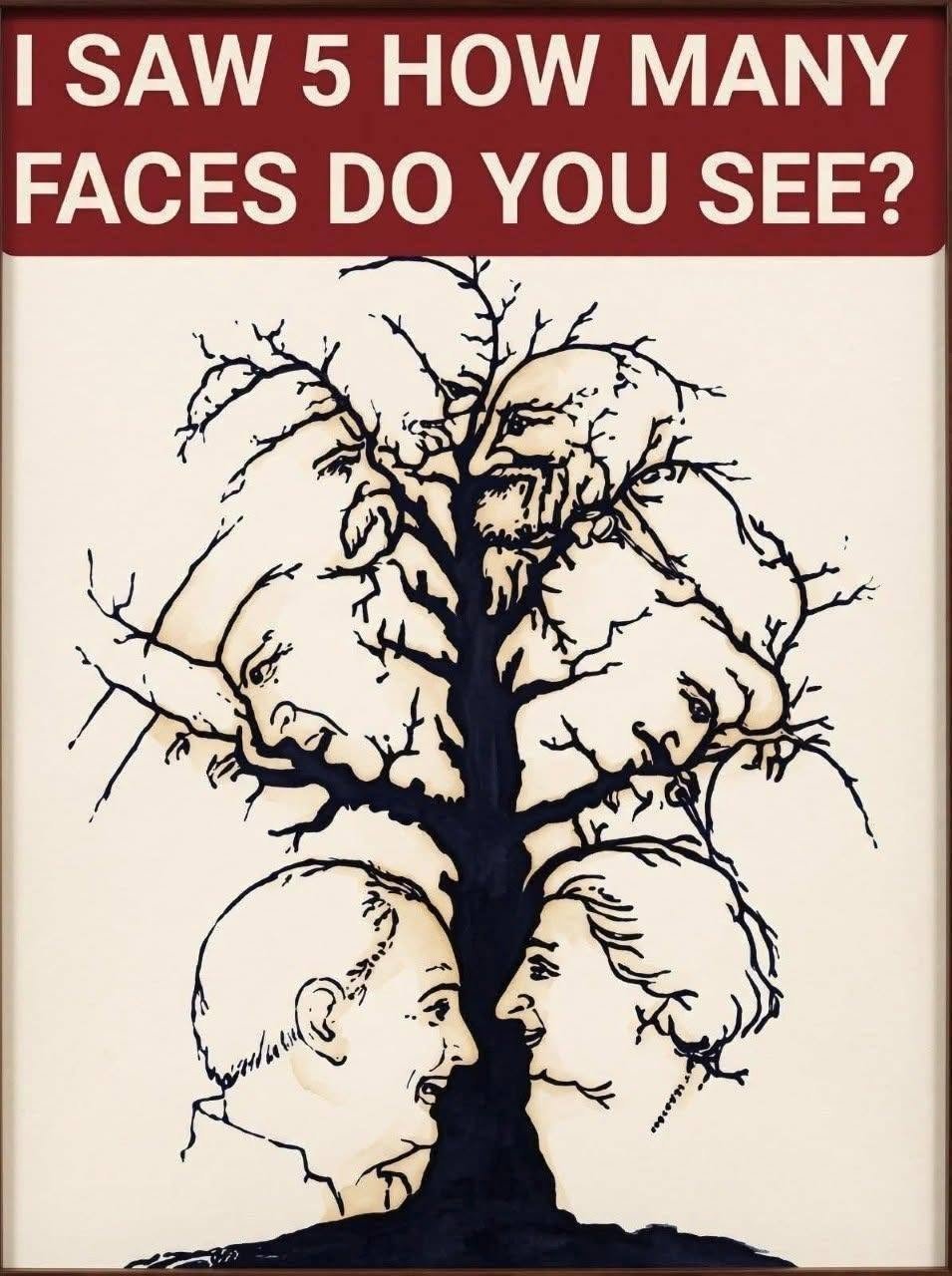
At first glance, it looks like an ordinary illustration of a tree. Its twisting branches, textured trunk, and intricate patterns blend together to form a peaceful natural scene. But look a little closer, and you might discover something startling: human faces cleverly concealed within the artwork.
This fascinating hidden-face puzzle challenges viewers to examine the image closely and count just how many faces they can recognize.
Some people spot only one or two right away. Others uncover dozens of hidden profiles after studying the image for several minutes.
The big question is: How many hidden faces can you find?
The Hidden Faces Tree Puzzle: More Than Meets the Eye
Hidden-face illustrations combine artistic creativity with the mechanics of visual perception.
An artist can arrange branches, leaves, shadows, and empty spaces in ways that subtly mimic recognizable human features. A curved branch might form a distinct forehead, while two small knot-holes could easily pass for eyes. The sweeping outline of a tree trunk might even hint at a nose, a mouth, or an entire profile.
What makes these illustrations so gripping is that the hidden images often remain invisible until your perspective shifts. You might initially see nothing more than a standard tree, but once you spot a face, it can suddenly become impossible to unsee—and the longer you look, the more details emerge.
Can You Find All the Faces in 30 Seconds?
Before continuing, put your observation skills to the test with a quick challenge:
-
Study the tree illustration carefully for 30 seconds and try to spot as many human faces as possible.
-
Avoid rushing to count the first few obvious faces you notice.
-
Scan different zones of the artwork—pay attention to the trunk, the sprawling branches, the clusters of leaves, and the negative spaces in between.
-
Keep in mind that faces come in all sizes; some occupy a massive section of the tree, while others are built from just a few subtle lines.
Once the time is up, tally your count. Then, take a second look. Did you notice any additional faces the second time around? That satisfying moment of discovery is what keeps us coming back to visual puzzles.
Why Are Hidden Faces So Difficult to Spot?
Our brains are remarkably hardwired to recognize human faces. From infancy, we learn to pick out familiar facial expressions, features, and patterns from our surroundings.
However, this acute sensitivity can also trick us into seeing faces where none actually exist—a psychological phenomenon known as face pareidolia.
Face pareidolia occurs when the brain interprets ambiguous visual data as a face. It’s the exact reason you might spot a friendly grin in the front grille of a car, a profile in a rock formation, or an expression in the grain of a wooden door. Hidden-face illustrations capitalize on this exact tendency, deliberately shaping lines and shadows to trigger multiple interpretations.
The Science Behind the Tree Optical Illusion
To understand why this puzzle works, it helps to look at how visual perception operates. When we look at an image, our eyes gather raw data about lines, colors, shapes, and contrast, while our brains rapidly organize that information into coherent objects.
A key concept here is figure-ground perception—the brain’s ability to distinguish an object from its surrounding background. In a hidden-face tree illustration, the boundaries between the tree and the faces blur and overlap:
-
What looks like part of a branch suddenly forms the crisp outline of a cheekbone.
-
A patch of dark shadow between leaves instantly transforms into an eye.
This mental shift is what makes optical illusions so magical. The physical image never changes; only your brain’s interpretation of it does.
Seven Clever Tricks to Find More Hidden Faces
If you are struggling to uncover every single face, try applying these expert strategies:
-
Start With the Trunk: The trunk is usually the densest and most texturally complex part of the tree. Look for knots, twists, and overlapping curves that form facial contours.
-
Trace the Branches: Branches create unexpected silhouettes. Look for sweeping limbs that could double as a chin or a forehead.
-
Scan the Negative Space: Sometimes the hidden face isn’t formed by the tree itself, but by the empty gaps between the branches.
-
Search for Varied Sizes: Don’t assume all faces are scaled equally. Scan for massive overarching profiles alongside tiny, hidden micro-faces.
-
Change Your Viewing Distance: Step back to get a macro view of larger patterns, then lean in close to catch finer details.
-
Look for Side Profiles: Remember that not every face will look straight ahead; many will be hidden in profile.
-
Take a Break: If your eyes start playing tricks on you, look away for a moment and return with fresh attention.
Why Do Some People See More Faces Than Others?
Have you ever wondered why one person can spot ten faces instantly while another sees only a tree? It usually boils down to a few factors:
-
Visual Attention: Different people naturally scan different focal points of an image.
-
Experience: Those who regularly solve puzzles are more attuned to an artist’s hiding techniques.
-
Expectations: If your brain expects a tree, it will prioritize branches—until you actively shift your mindset to look for faces.
-
Image Quality: High-resolution displays and good contrast make subtle micro-details much easier to pick out.
Are Hidden-Face Puzzles Good for Your Brain?
While these puzzles won’t serve as a clinical intelligence test, they offer a fantastic mental workout. Searching for hidden faces sharpens several cognitive skills:
-
Pattern Recognition: Training your brain to isolate facial features within chaotic shapes.
-
Visual Attention & Focus: Teaching your eyes to slow down and thoroughly scan an environment.
-
Flexible Thinking: Practicing how to switch rapidly between two entirely different interpretations of the same visual data.
Turn It Into a Family Challenge
Want to make things more interesting? Turn this optical illusion into a game with friends or family:
-
Show everyone the exact same tree illustration.
-
Set a timer for 30 seconds and have each person quietly write down how many faces they found.
-
Compare notes, then give everyone another minute to point out where their discovered faces are located.
You will likely be amazed by how differently two people can look at the exact same picture!
Final Thoughts: How Many Faces Did You Find?
The hidden-faces tree illustration is a brilliant reminder of how dynamically our brains interpret the world around us. What starts as a simple sketch of nature can transform into a bustling mosaic of hidden identities the moment you change your perspective.
Now it’s your turn: How many faces did you manage to spot? Did you find them all immediately, or did you need a second look?
For Complete Cooking STEPS Please Head On Over To Next Page Or Open button